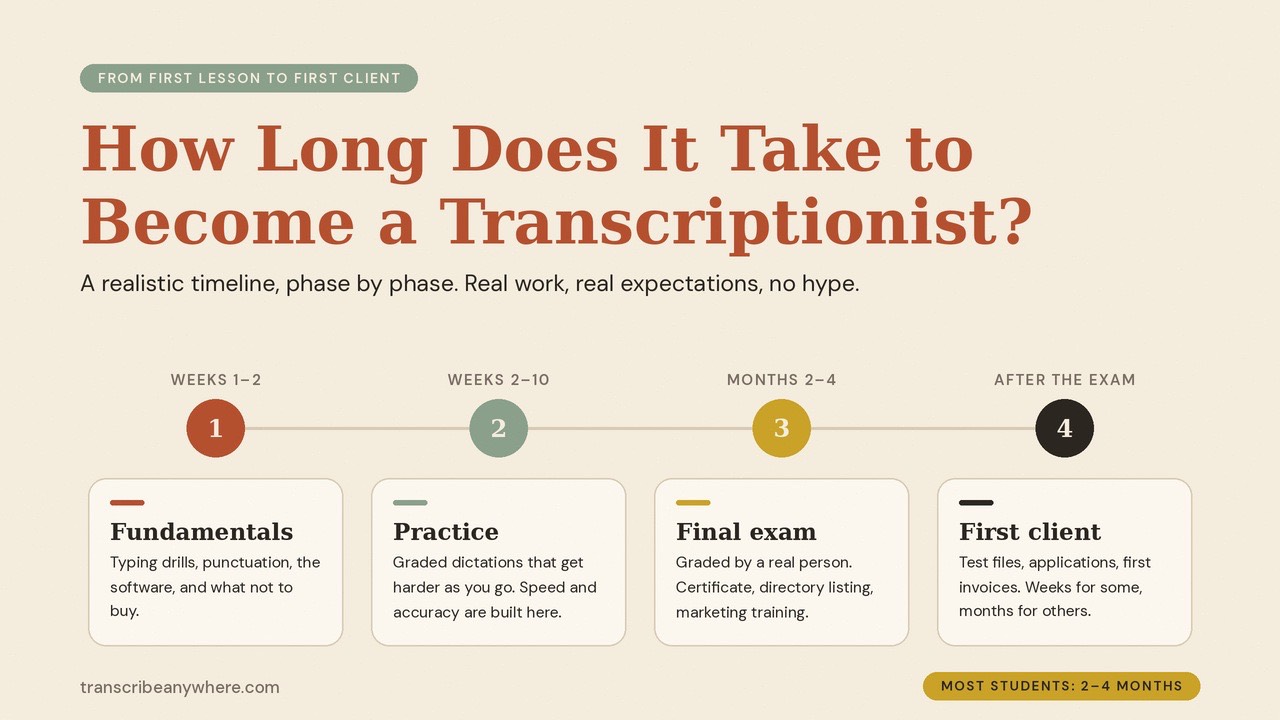
To become a transcriptionist, you start by choosing a type of work. General transcription has the lowest barrier to entry, because vendor sources say no specialized knowledge or formal training is needed. Medical and legal transcription call for specialized training or certification. Pay and demand are limited and uncertain, so treat it as a skill to test, not a sure income.
The sources behind this guide are two transcription company blogs (GoTranscript and Transcription HUB) and a test-prep site, ConnectPrep, that relays U.S. Bureau of Labor Statistics (BLS) data. The companies sell transcription services, so their claims are attributed to them, not treated as verified.
What does a transcriptionist do?
A transcriptionist turns audio or video into written text. GoTranscript says general projects include business meetings, conference calls, and closed captions for shows and movies.
Medical work is more specific. ConnectPrep lists typical duties as transcribing dictated reports, expanding abbreviations, editing, and checking with doctors when there are errors.
A related job is CART, short for Communication Access Real-Time Translation. GoTranscript says CART transcriptionists help deaf or hard-of-hearing people by capturing spoken words and non-verbal sounds. It adds that some general transcriptionists move into this work. The sources give no training details for CART, so check requirements with any employer or provider directly.
GoTranscript also says most transcriptionists are independent contractors who manage their own workload and deadlines. That is a vendor statement, not verified data. It does mean you may be paid per project and responsible for your own taxes and equipment. This article gives general information only, not tax or legal advice.
How do you become a transcriptionist?
The path depends on the type you choose. The steps below follow what the sources say.
- Pick a type. General transcription is the usual starting point. Medical and legal require extra learning first.
- Check your basic skills. You need to listen closely and type quickly and accurately (see the skills section below).
- Practice on general audio. Transcription HUB says no formal training is needed for general transcription, only about a month of practice. That "one month" figure is the vendor's claim, not a verified norm. Your own timeline may differ.
- Add training only if you aim at medical or legal work. GoTranscript suggests completing a medical transcription program or certification and learning medical vocabulary. For legal work, it says you must learn legal terminology and procedures.
- Vet every offer before you give personal details or pay anything. The guide to evaluating an online program covers the basics.
The research does not give program prices, certification costs, or hiring timelines, so none are listed here. Get costs in writing from any training provider before you enroll.
What are the three main types of transcription work?
| Type | What it involves | Training, per the sources | Caveats |
|---|---|---|---|
| General | Meetings, calls, captions | GoTranscript: no specialized knowledge needed to start. Transcription HUB: no formal training, about a month of practice | Transcription HUB calls it "easier to get into but more difficult to perform" because audio can be poor and speakers can overlap |
| Medical | Dictated reports from healthcare settings | GoTranscript: knowledge of medical terminology, and certifications "may" be demanded. Transcription HUB: training must cover anatomy, diseases and treatments, drug names, and surgical procedures, with ongoing updates | The sources describe certifications loosely and name no certifying body |
| Legal | Legal recordings and documents | GoTranscript: a law degree is "not always needed," but certifications are "usually required." Transcription HUB: formal training is needed | The two sources differ on "certification" versus "formal training," so confirm with the specific employer |
The practical point is that the easiest door to open, general transcription, is also described as hard to do well. Low entry barriers also mean more people can try it. The sources do not measure how that affects pay.
What skills do you need to start?
Both vendor sources name similar skills:
- Careful listening
- Fast, accurate typing
- Grammar and proofreading
- Computer and software skills
- Research ability, such as looking up unfamiliar names and terms
- Formatting transcripts to a client's specifications
Medical and legal work add vocabulary and subject knowledge on top of this list.
Is transcription a realistic way to earn money?
The only hard numbers in the research are for medical transcriptionists. ConnectPrep says it reproduces BLS data unaltered, but it is a secondary source. Check the figures at bls.gov before relying on them.
- Median annual wage: $40,410 (May 2025). This is the midpoint for all workers in the occupation, not starting pay, and not a promise of what you would earn.
- Projected employment change, 2025 to 2035: a decline of 4.4%, compared with growth of 3.5% for all occupations.
- Openings: about 6,200 per year, counting both new jobs and replacement needs.
- Typical entry credential: a postsecondary nondegree award.
A shrinking projection does not mean no one is hired, since the openings figure includes people replacing those who leave. It does mean this is not a growing field by BLS projections. The research has no comparable BLS figures for general or legal transcription, so this article makes no claims about their pay or demand.
Transcription may suit you if you are detail-oriented, can focus on audio for long stretches, and want to test a skill with a low entry barrier. It may not suit you if you need predictable income soon, dislike repetitive work, or hope to build a career in medical transcription based on growth.
FAQ
Do you need training to become a transcriptionist?
For general transcription, the vendor sources say no formal training is needed. Transcription HUB suggests about a month of practice. Medical transcription needs medical terminology training, and GoTranscript says legal work usually requires certification. The sources differ on legal requirements, so confirm with the employer.
How do you spot a transcription job scam?
Be wary of any offer that asks you to pay to get work, or that sends you a check and asks you to send money back. Verify the company through its own website, not through the message that contacted you. The site's guide on how to know if a job is a scam lists warning signs. To see what one transcription marketplace's terms say, read Is Rev legit?
How much do transcriptionists earn?
The research only supports a figure for medical transcriptionists. BLS data relayed by ConnectPrep puts the median annual wage at $40,410 (May 2025). That is not typical for a beginner and not guaranteed. The research has no sourced pay figures for general or legal transcription.
Is transcription work declining?
For medical transcription, BLS projects employment to fall 4.4% from 2025 to 2035. The research doesn't cover general or legal transcription trends. If you are comparing options, see realistic remote careers with no experience.