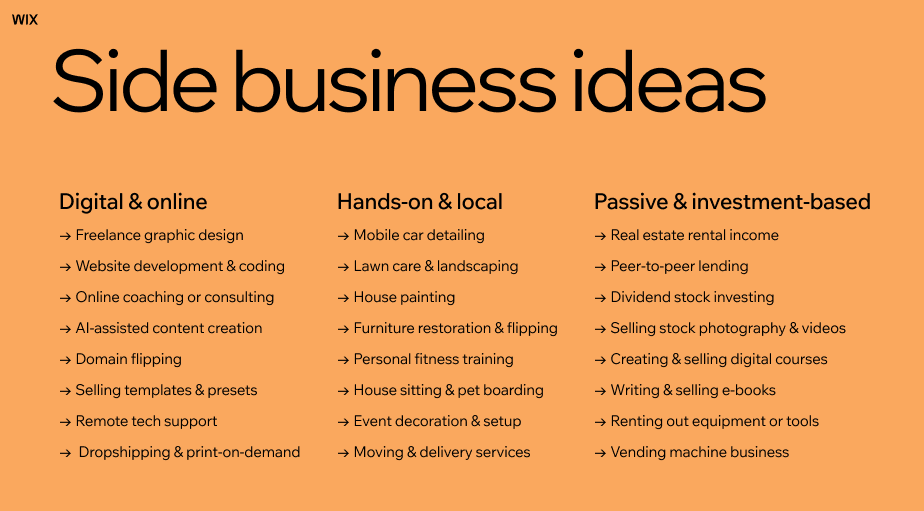
Many people explore part time business ideas to earn supplemental income while keeping their current job. The reality is that success depends on matching an idea to your existing skills, available hours, local or online demand, and willingness to handle both the work and the business side. Most new businesses take significant time before producing consistent revenue, and about 34% of startups fail due to lack of product-market fit.
What to Consider Before Starting a Part-Time Business
Before committing time or money, evaluate several practical factors. These include your current skill set and any credentials or licenses required, whether you plan to operate part-time or eventually full-time, how many clients or sales you might need, and how many hours per week you can realistically dedicate.
Other important considerations are startup capital, equipment needs, whether you plan to hire help, your location or target market, and whether the business will be online or in-person. Businesses built on existing expertise tend to launch faster and cost less. Service-based and home-based options often require fewer upfront resources than product-based ventures.
Careful financial planning is one of the strongest predictors of long-term success, according to the U.S. Small Business Administration. Readers should research any licensing, certification, or local regulations that apply to their specific idea and location, as requirements vary widely.
Typical Startup Costs for Different Business Types
Startup costs vary significantly depending on the business model. Service businesses typically launch for $3,000-$15,000, while many home-based businesses start for under $5,000. Digital products or a dropshipping store can reportedly start for under $500, which is roughly 0.03 times the cost of a $15,000 service business benchmark. These figures come from a cost survey and represent reported ranges, not guarantees.
Here are some documented cost ranges:
- Residential cleaning service: $1,000-$2,000
- Online store: $1,000-$60,000
- Lawn care or gardening: $3,000-$10,000
Online businesses such as an online store or dropshipping operation allow you to reach customers anywhere without the overhead of a physical location. However, even low-cost models involve ongoing expenses such as marketing, software subscriptions, or platform fees that are not included in these startup figures. Always calculate both initial and continuing costs for your specific situation.
Matching Ideas to Your Skills and Available Time
Part time business ideas work best when they align with skills you already have, so you can begin generating activity without months of training. Virtual assistant work, tutoring, cleaning, or creating digital products are often cited as examples that can fit around a day job, but each still requires consistent effort.
Some opportunities demand more experience, credentials, licenses, or additional education than others. For instance, tutoring or consulting may leverage professional background, while service businesses like residential cleaning or lawn care may need equipment and local marketing. Choose ideas that fit the hours you have available each week without burning out.
Because the business is part-time, expect slower growth. Many owners keep their primary job while testing whether the new venture has enough demand to justify more time. This approach reduces financial risk but limits how quickly the business can scale.
How to Validate Demand as a Side Hustle
Before investing significant time or money, test demand while still employed. Start small, offer your service or product to a limited audience, and gather direct feedback. Online businesses have an advantage here because they can reach a wider market without geographic limits.
About 34% of startups fail due to lack of product-market fit. Treating the business as a side hustle first gives you time to adjust your offering based on real customer response rather than assumptions. Track actual interest, inquiries, and sales over several months before deciding whether to expand.
Remember that income from any new business is unpredictable. There are no guarantees, and results are not typical. Many owners report that it takes longer than expected to build steady revenue. Focus on validating that enough people are willing to pay for what you offer before quitting your job or investing more than you can afford to lose.
FAQ
How much does it cost to start a part-time business?
Costs vary by type. Service businesses typically launch for $3,000-$15,000, while many home-based businesses start for under $5,000. Digital products or dropshipping can reportedly begin for under $500. These are ranges from industry surveys and do not include ongoing expenses. Research your specific idea thoroughly, as actual costs depend on equipment, marketing, licenses, and location.
Can you run a part-time business entirely from a laptop?
Yes, some ideas such as selling digital products, offering virtual assistant services, or running a dropshipping store can be managed primarily from a laptop. These avoid physical inventory or a storefront. However, even laptop-based businesses usually require marketing, customer service, and administrative work that take real time each week. Not every part-time idea works exclusively online.
What are the main risks of starting a part-time business?
The biggest risks are spending time and money without generating enough demand, which leads many startups to close. About 34% of startups fail due to lack of product-market fit. Part-time operation can slow growth and make it harder to compete with full-time businesses. There are no guaranteed earnings, and most new businesses take longer to become sustainable than owners initially expect.
Should you start a part-time business using your current skills?
Businesses built on existing expertise tend to launch faster and cost less. Starting with skills you already have reduces the need for expensive training or credentials. Still, you must verify that people in your target market are willing to pay for those skills. Validate demand as a side hustle before scaling.
How do you know if a part-time business idea is worth pursuing?
Test the idea on a small scale while keeping your current job. Look for actual paying customers rather than interest alone. Evaluate whether the time required fits your schedule and whether ongoing costs stay within your budget. If you cannot find consistent demand after several months of testing, the idea may not be viable for you.
[Internal links: For more small business frameworks, see this Xero guide to small business ideas. Learn how to evaluate an online program before investing in any training or tools. Readers interested in realistic earning options may also want to review how to work for yourself as a beginner freelancer and how to make money without a job.]